
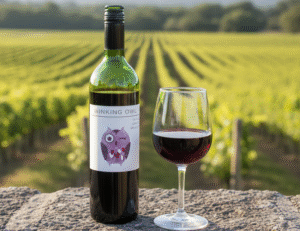

Why is Winking Owl Wine so cheap? The answer is mostly about efficiency, scale, and brand strategy. Aldi’s private label wine is called Winking Owl. Private labels are designed to reduce expenses without significantly sacrificing quality.
Aldi doesn’t invest in ostentatious packaging or expensive advertising efforts. They sell wine at almost unbelievable prices because they maintain efficient production and concentrate on large-scale sales.
Large commercial vineyards with enormous production capacity are the source of Winking Owl wine. The price per bottle decreases dramatically when vineyards produce wine on this scale. Consider it similar to purchasing groceries in bulk.
The cost per unit decreases as the batch size increases. The wine in the bottle is frequently quite comparable to more expensive wines. Aldi just omits the extra procedures used by boutique wineries, such as costly branding, small-batch fermentation, and hand labeling.
Why is Winking Owl Wine So Cheap
Aldi avoids middlemen, which is the main factor that makes Winking Owl Wine so inexpensive. Before being placed on the shelf, the majority of wines you see in stores pass via a number of distributors, wholesalers, and retailers. A markup is added at each step. Because Winking Owl wine is a store brand, it avoids all of that. Aldi sells directly to consumers and purchases straight from manufacturers. Lower costs result from fewer layers.
Another factor is packaging. There is minimal luxury presentation, the bottles are straightforward, and the labels are clear. In the process of making wine, all that design and material costs quickly mount up. Aldi saves money by using less packaging, which is then passed on to customers.
See also: Is Winking Owl wine good
Aldi engages in forceful negotiations with producers as well. They can negotiate better prices because they sell so many bottles. The wineries are able to reduce their pricing since they are aware that they will receive large orders. Such discounts would never be seen at small wineries. For comparable flavor experiences, Winking Owl can so compete with wines that cost twice or three times as much.
The fact that inexpensive wine does not automatically equate to poor wine is one factor that frequently surprises people. Although Winking Owl wines are usually mass-produced, they adhere to established production procedures, which ensure their safety, consistency, and drinkability. Although boutique techniques and creative blends are unlikely to be found, the flavor profile is consistent. Instead of paying for a wine adventure, you are paying for a reliable wine.
What makes Winking Owl The size of the market also contributes to the low cost of wine. Winking Owl is made to appeal to the typical wine drinker, since Aldi is a worldwide retailer. The brand doesn’t strive to compete with high-end wines or win contests. Accessibility is its aim. They can manufacture big quantities thanks to their all-encompassing strategy without worrying about exclusivity or niche appeal. Affordability is driven by volume.
One aspect that people frequently ignore is Aldi’s inventory management strategy. They don’t keep too much wine in storage because they change their supply frequently. Quick turnover lowers storage expenses and waste. Fast-moving wine is less expensive to handle and store, which further drives down costs.
Why does Winking Owl Wine have such low prices? It also includes the grapes themselves. Many of these wines are produced from more robust and prolific grapes. The vineyards prioritize productivity above uncommon varieties. Although the wine produced from these grapes is ideal for everyday use, it would never be classified as premium. Because raw materials are less expensive, the price of bottles is kept low.
Labor is another factor. For manual tasks, boutique wineries frequently hire specialized staff, which raises costs significantly. With very little human involvement, Winking Owl wines are primarily machine-processed. Labor costs are decreased by automation, and Aldi does not pass those savings along to customers.
Another factor contributing to Winking Owl Wine’s low price is its distribution network. From manufacturing to retail, Aldi controls the supply chain. Because every stage is under control, there is no need to hire other businesses to store or transport wine. Outside of major retailers, this degree of efficiency is uncommon. The price tag immediately reflects the savings.
Aldi’s established agreements with producers also allow for better management of taxes and import fees. Because of the volume, they frequently negotiate special rates or source from areas with cheaper export expenses or taxes. Although it can appear to be magic, it is only astute business strategy.
Why does Winking Owl Wine have such low prices? Another reason for this is that Aldi doesn’t make an effort to project an air of grandeur. Many wine businesses invest a lot of money on advertising efforts that imply prestige or excellence. Winking Owl doesn’t complicate things. You are not purchasing an influencer endorsement, a lifestyle photo, or a story. Simply put, you are paying for the liquid that is in the bottle.
In fact, this is a comfort for a lot of people. You can purchase a bottle without questioning whether the price is excessive given what it offers. You receive a predictable, affordable, and drinkable wine. It is the antithesis of purchasing something for publicity or prestige. Practical enjoyment is prioritized over status signaling.
Aldi’s straightforward approach to retail is advantageous to Winking Owl as well. Low overhead, a minimal selection, and the store’s layout all help you understand why is Winking Owl Wine so cheap. Aldi maintains a small selection of wine brands, which boosts productivity and lowers expenses, in contrast to larger shops that carry hundreds. Less complexity translates into lower costs.
Lastly, what makes Winking Owl Wine so inexpensive? It combines direct sourcing, minimum packaging, large-scale production, and operational efficiency. Aldi strives to maintain low pricing without compromising quality in whatever decision it takes. That’s the recipe for a reasonably priced, five-dollar bottle of wine.
Wine from Winking Owl is not the same as wine from a boutique. You do not receive a complicated, multi-layered tasting experience, but you do receive a reliable, reasonably priced beverage. It’s suitable for informal dinners, gatherings, or lounging around the house guilt-free. Instead of rarity or status, you are paying for dependability and accessibility.
In conclusion, Winking Owl is inexpensive because that is how Aldi designed it. Large quantities, direct sourcing, effective supply chains, little promotion, and a straightforward strategy all work together to produce a wine that is unexpectedly affordable and drinkable. It is a wise choice for regular wine consumers. Several bottles can be kept in your refrigerator without breaking the bank.
Appreciating what you are getting is made simpler when you know why is Winking Owl Wine so cheap. It is not meant for a connoisseur’s cellar, but rather for general consumption. It offers a reliable drinking experience free of unexpected fees. Winking Owl provides its clients with straightforward, reasonably priced, and reliable wine—exactly what they want in a world where wine pricing might seem daunting.